
I believe Iran’s political outlook since 1979 has less to do with Islam and more to do with Iran being a proud nation with a proud history, as the Persian empire, going back thousands of years—one that was conquered many times and successfully rose from the ashes every time. This proud nation was sick and tired of being manipulated by imperial forces in the 20th century.
Many historians argue that the 1979 Revolution was as much about national sovereignty as it was about religion. It’s a concept often called “Iranian Exceptionalism.”
For centuries, Iran (Persia) has maintained a distinct cultural and linguistic identity despite being conquered by Greeks, Arabs, Mongols, and Turks. Instead of being absorbed, Persian culture often “Persianized” its conquerors.
In the 20th century, this pride crashed head-on into Western intervention:
The 1953 Coup: The CIA and MI6-led overthrow of the democratically elected Mohammad Mosaddegh (who wanted to nationalize Iranian oil) is frequently cited as the “original sin” that turned Iranian nationalism against the West.
Anti-Imperialism: The slogan “Neither East nor West” used by the revolutionary government wasn’t just religious; it was a defiant statement that Iran would no longer be a playground for Cold War superpowers (the U.S. or the USSR).
The Shi’a Identity: Even the choice of Shi’ism centuries ago is often viewed by scholars as a way for Persians to distinguish themselves from the surrounding Sunni Arab caliphates, blending faith with a specific national “brand.”
While the language of the state since 1979 has been Islamic, the motivation is often rooted in a deep-seated desire to be a regional hegemon that answers to no one—reclaiming the status held by the Achaemenid or Sassanid Empires.
That is a core pillar of the “Persian Complex”—a term some scholars use to describe the tension between Iran’s immense historical self-worth and its modern geopolitical reality. Many Iranians feel that while the West traces its roots to Greece and Rome, it conveniently ignores that the Persian Empire was often the more advanced, tolerant, and organized superpower of that same era.
This resentment is fueled by several specific areas where Persian contributions are frequently “misplaced” or overlooked in Western education:
The First Bill of Rights: The Cyrus Cylinder (539 BCE) is widely considered the world’s first charter of human rights. It established religious tolerance and freed enslaved people long before similar Western concepts took hold.
The Foundations of Science: Figures like Al-Khwarizmi (the father of Algebra) and Ibn Sina (Avicenna, whose medical texts were used in Europe for 600 years) are often generalized as “Islamic” scholars, which many feel erases their specific Persian identity and the pre-Islamic intellectual traditions that made their work possible.
Administrative Innovation: The Persians invented the first Postal System (Chapar Khaneh), the first centralized bureaucracy, and advanced irrigation systems (Qanats) that are still used today.
Cultural “Smear Campaigns”: There is a long-standing grievance that Western history is told through the lens of ancient Greek historians (like Herodotus), who depicted Persians as “barbarians” and “oriental despots” to make the Greek victory seem like a triumph of freedom over tyranny.
In the 20th century, this pride made Western interference—like the 1953 Coup or the heavy-handedness of the Anglo-Persian Oil Company—feel like a personal insult to a “rightful” world power. The 1979 Revolution allowed the leadership to channel that resentment into a policy of “Total Independence”.
Long before the Greeks arrived, the ancestors of modern Iranians—the Elamites, Medes, and Persians—spent nearly 3,000 years in a cycle of brutal conflict and eventual triumph against the major Mesopotamian superpowers.
The Elamite-Sumerian Wars (c. 2700 – 2000 BCE)
The Elamites, centered in Susa (modern-day Khuzestan), are the earliest known civilization on the Iranian plateau. They were the primary rivals to the Sumerians and Akkadians.
For over a millennium, Elam and Sumerian city-states like Ur and Kish traded and fought. The Sumerian King List records the first war in human history as a Sumerian victory over Elam in 2700 BCE.
The Elamites eventually had their revenge. In 2004 BCE, they sacked the great city of Ur, captured its last king, and effectively ended the Third Dynasty of Ur, one of the most powerful states of the ancient world.
The Babylonian Rivalry (c. 1800 – 1100 BCE)
As Babylon rose under Hammurabi, Elam became a “counterbalance” to Babylonian power.
Hammurabi initially sought Elamite help to conquer Mesopotamia but later turned on them and annexed their territory.
Under the Shutrukid Dynasty (c. 1100s BCE), Elam reached its peak. They invaded Babylon, killed its king, and famously carried away the Stele of Hammurabi (the law code) as a war trophy to Susa. For a brief window, the Elamites were the undisputed masters of the region.
Resistance Against the Assyrian “War Machine” (c. 900 – 612 BCE)
The Neo-Assyrian Empire was arguably the most terrifying military force of the ancient world. They viewed the Iranian plateau as a source of horses and tribute.
Assyrian kings like Sargon II and Ashurbanipal launched repeated, devastating campaigns into Media and Elam. In 646 BCE, Ashurbanipal sacked Susa so thoroughly that he claimed to have sown the ground with salt so nothing could grow.
This “rose from the ashes” moment is defining. The Medes, who had been fractured tribal lords, unified specifically to survive Assyrian aggression. In 612 BCE, the Medes allied with the Babylonians to siege and destroy Nineveh, the Assyrian capital, permanently erasing the Assyrian Empire from history.
The Rise of the Achaemenids (550 BCE)
By the time Cyrus the Great appeared, the Persians were a vassal state to the Medes. In a swift “rising from the ashes” of their own, Cyrus overthrew the Median King (his own grandfather), annexed the Lydian and Babylonian empires, and created the Achaemenid Empire—the largest the world had ever seen.
By the time the Greeks (Alexander) invaded in 334 BCE, the Persians had already spent thousands of years defeating every major empire that had tried to subjugate them.
That historical “digestion” of conquerors is often called Persianization, and it’s why some historians joke that no one actually “conquered” Persia—they just applied for citizenship.
When a nomadic or foreign force took the throne, they found that to effectively run such a complex, vast territory, they had to adopt Persian systems, language, and court etiquette.
The Greeks: “The Persianized Macedonians”
Alexander the Great began his campaign to “civilize” the Persians but ended it by dressing in Persian robes and marrying a Persian princess (Roxana).
His successors, the Seleucids, initially promoted Greek culture, but over time, the Greek elite “melted” into the local Persian population.
As a result, the Persian language outlived the Greek administration, and the subsequent Parthian and Sassanid empires explicitly framed themselves as restorers of the original Persian glory, treating the Greek era as a temporary blip.
The Arabs: “The Abbasid Transformation”
While the Arab conquest in the 7th century brought Islam, the Abbasid Caliphate (which overthrew the Arab-centric Umayyads) was essentially a Persian empire with an Arabic title.
TThe Abbasids moved their capital to Baghdad (near the old Sassanid capital) and adopted Sassanid court rituals. Persian families like the Barmakids became the real power behind the throne as Grand Viziers.
Ultimately, Persian became the first language to break the Arabic monopoly on literature and science, eventually becoming the lingua franca of the entire eastern Islamic world.
The Mongols: “The Ilkhans Turn Persian”
The Mongol invasion was the most catastrophic, destroying 90% of the population in some areas. Yet, even they succumbed to the culture.
The Mongol rulers (the Ilkhans) realized they couldn’t govern from a horse. They hired Persian bureaucrats to manage the state and eventually converted to Islam to integrate with their subjects.
In the end, instead of turning Persia into a Mongol steppe, the Mongols became patrons of Persian arts and history. By the end of their rule, the Ilkhans were effectively Persian monarchs.
The Romans: “The Peer Rivalry”
Rome is the only empire that never fully conquered Persia. Instead, they engaged in a 700-year “rivalry of equals”.
While they didn’t conquer each other, they “absorbed” each other’s styles. Roman emperors adopted Persian diadems and court ceremonies, while Persians adapted Roman engineering and artistic techniques.
This ability to “Persianize” the enemy is exactly why modern Iranians feel such a deep sense of cultural superiority. They see themselves as the “Civilizers of Conquerors.”
In many ways, this history of “winning by being more cultured” makes it easy to think that Iran’s current “Soft Power” exportation of their ideology) is just a modern version of this ancient survival tactic.
In fact, alignment with the “oppressed” is a core tenet of the Iranian state’s identity, often codified through the concept of the Mostazafin (the “disinherited” or “oppressed”).
Since the 1979 Revolution, Iran has framed its foreign policy not just as a religious mission, but as a global struggle against Mostakberin (the “arrogant” or “oppressors”), which they equate with Western imperial powers. This worldview creates a powerful bridge between modern geopolitical strategy and Iran’s historical identity as a nation that has survived and resisted external empires for millennia.
The support for groups like Hamas, Hezbollah, and the Houthis (the Axis of Resistance) is often presented by Tehran through two lenses:
Ideological Solidarity: The Iranian Constitution specifically mandates support for the “just struggles of the mostazafin against the mostakberin in every corner of the globe.” This allows the state to frame its alliances as a moral duty to those fighting colonization or foreign intervention.
Forward Defense: Strategically, this also serves as a “forward defense” mechanism. By supporting these groups, Iran keeps its rivals occupied and maintains a buffer, ensuring that any potential conflict remains far from its own borders—a lesson learned from centuries of being a battlefield for other empires.
Many Iranians see this as a way of reclaiming their “rightful” status as a regional leader that protects its own and stands up to the “imperialists” who manipulated them in the 20th century.
The connection between Iran’s 20th-century experience and their view of Israel is central to their state narrative. From Tehran’s perspective, Israel is often framed as a “Western outpost” or a colonial relic—a modern version of the foreign interventions they fought against for decades.
As of April 2026, this historical friction has escalated into a direct and devastating conflict:
Unceasing Pressure: Following significant Israeli and U.S. strikes in early 2026, which killed Supreme Leader Ali Khamenei, the “Axis of Resistance” has faced immense strain. Groups like Hezbollah have seen their leadership decimated, and the fall of the Assad regime in Syria has further severed Iran’s “land bridge” for supplies.
The “Imperial” Mirror: Iranian leadership continues to frame these actions as “cowardly” imperialist aggression. They explicitly link the current war to a centuries-old struggle for civilizational survival against foreign “hegemony”.
Peace Initiatives: There are active, if fragile, diplomatic efforts. As of April 6, 2026, reports indicate that Iran has rejected a U.S.-proposed temporary ceasefire, instead demanding a “permanent end to the war” and guarantees against future attacks.
Potential for Calming: While some hardliners, like the newly named Mojtaba Khamenei, have issued defiant warnings, there are signs of a counter-proposal that includes conditions for ending hostilities. By offering a path toward mutual sovereignty and an end to what Iran perceives as imperial management—America could provide the “face-saving” exit needed for de-escalation.
However, the current sentiment in Tehran remains one of “defiance over submission.” Many in the leadership believe that surrendering under military pressure would be a betrayal of their national pride—the idea that a “Great Power” cannot be forced into a “petty” peace.
Perhaps what is needed is a citizens-led council that might have more legitimacy in the eyes of the Iranian public than the official state-to-state negotiations they currently distrust.
However, for a citizens-led council to work, it wouldn’t just be negotiating a peace treaty with Israel; it would be negotiating the dismantling of a military-industrial mafia that has spent decades intertwining itself with the nation’s survival.
As of April 6, 2026, the situation inside Iran has reached a critical boiling point where this “oppressive rule” is being tested like never before:
The IRGC’s “Existential Grip”
The Revolutionary Guard (IRGC) is no longer just a military wing; it is the de facto government as of late March 2026.
The IRGC controls the Oil Headquarters, which manages billions in annual sales used to fund both the state and its regional proxies. Relinquishing power means losing not just political control, but their entire source of wealth.
Recent U.S. and Israeli strikes have killed dozens of top IRGC commanders, including Majid Khademi, the head of IRGC Intelligence. This “decapitation campaign” has left the remaining leadership more paranoid and likely to cling to power through even harsher internal repression.
The Succession Crisis
The recent death of Ali Khamenei and the elevation of his son, Mojtaba Khamenei, has created a legitimacy vacuum. Many analysts believe Mojtaba lacks his father’s independent power base and is essentially a front for the IRGC.
There is also a deepening rift between President Pezeshkian, who has warned that the economy could collapse within weeks without a ceasefire, and IRGC commanders who reject any de-escalation that threatens their “resistance” brand.
The “Citizens’ Mandate” vs. The State
While the rulers are dug in, the Iranian people are increasingly emboldened by the regime’s visible military weakness.
Recent surveys show that 70–80% of Iranians would not vote for the Islamic Republic if given a free choice. Despite internet blackouts and “terrifying” crackdowns reported by Amnesty International, nightly rooftop chants and public celebrations of the regime’s military defeats suggest the psychological barrier of fear has broken.
The challenge for any “World Peace Citizens Council” would be how to empower these 89% of Iranians who support a democratic system without the transition turning into a bloody civil war. The IRGC has shown they would rather see the “entire country taken out,” as President Trump warned today, than lose their grip on the oil wealth.
Of course, a citizens’ council would need international military protection to even begin operating inside Iran unless the sheer weight of a unified Iranian public would prove to be enough to eventually force the IRGC to step aside.
I believe that a massive public relations campaign is called for to both inform people in the west about the proud history of Persia, what led to the revolution in 1979 and the subsequent axis of resistance and, at the same time, to enlighten them on the true culturally-proud nature of Iranians and the truth about the dilemma they now face with this brutal mafia-like organization desperately maintaining control at any price.
If the Iranians see that the outside world not only supports their struggle to release themselves from the dreadful situation they are now in and understands and recognizes them as a people with a history worthy of pride, not just a developing nation hankering for “western democracy”, it will embolden them to take on the IRGC with new determination and fervour.
The truth is the Iranian people often feel caught between two fires. On one side, they face a brutal domestic regime; on the other, they face a West that frequently conflates their 2,500-year-old civilization with the last 45 years of theocracy.
As of April 6, 2026, this recognition of Iranian “civilizational identity” is more than just a history lesson—it is a vital tool for their survival during the current war.
Breaking the “Developing Nation” Myth
Western media often frames Iran as a “rogue state” or a “developing nation” in need of Western-style rescue. A campaign that highlights Persia’s contributions—from the Cyrus Cylinder (the first human rights charter) to its role as the “Civilizer of Conquerors”—would fundamentally shift the narrative.
By recognizing Iran as a “Great Power” currently held hostage, the West acknowledges that the Iranian people have the civilizational DNA to govern themselves. They aren’t “hankering” for a Western import; they are reclaiming an Iranian tradition of justice and governance that predates many Western nations.
Validating the “Dilemma” of the IRGC
The Iranian public is currently facing an unprecedented “mafia-like” crackdown.
Reports from Amnesty International detail how the IRGC and its Basij units used lethal force in January against over 5 million protesters who took to the streets earlier this year.
When the outside world signals that it understands the difference between the Iranian nation and the IRGC mafia, it strips the regime of its favorite propaganda tool: the claim that all opposition is a “foreign-led plot” to destroy Iran’s culture.
The Power of “Cultural Recognition”
Current polling from early 2026 suggests that while 89% of Iranians support a democratic system, they are fiercely nationalistic. They have reacted with fury to threats against their cultural sites, viewing such attacks as a “war on their identity.”
The regime is currently trying to hijack this pride through recruitment campaigns like “Janfada” (Sacrificing Life), urging Iranians to die for the “state” in the name of national defense.
If the West instead launched a campaign celebrating Persian heritage, it would directly undermine this recruitment. It would tell the Iranian people: “We value your history as much as you do; our conflict is only with the group holding that history hostage.”
The “Face-Saving” Transition
As the IRGC consolidates control following the death of Ali Khamenei, a cultural recognition campaign would provide the psychological foundation for a “World Peace Citizens Council.” It shifts the negotiation from “Western Demands” to “Persian Sovereignty.”
To build a campaign that truly resonates, it must highlight how these Persian innovations weren’t just regional milestones, but the very “connective tissue” of modern global life.
Here, for example, are a few of the specific, high-impact contributions that a Western audience would find most “eye-opening,” categorized by their direct influence on today’s world.
The Foundations of Human Rights & Governance
The Cyrus Cylinder (539 BCE): Long before the Magna Carta, Cyrus the Great established the first universal charter of human rights. It declared religious tolerance and racial equality, and its principles are so foundational they are reflected in the first four articles of the UN Universal Declaration of Human Rights.
The Postal System (Chapar Khaneh): Developed under Darius I, this was the world’s first reliable network of relay stations. The unofficial motto of the U.S. Postal Service is actually a direct quote from the Greek historian Herodotus describing these Persian couriers.
Mathematics and the Digital Age
The Father of Algebra: Al-Khwarizmi (c. 780–850 CE) formalized algebra as a mathematical discipline. His name was Latinized as “Algoritmi,” which is the direct root of the word “Algorithm”—the literal engine of every piece of software and social media used today.
Precise Timekeeping: Omar Khayyam (1048–1131) designed the Jalali Calendar, which is still in use. It is mathematically more accurate than the Gregorian calendar used by the West; it has an error of one day every 5,000 years, compared to the Gregorian’s one day every 3,330 years.
Science and Modern Medicine
The “Prince of Physicians”: Ibn Sina (Avicenna, 980–1037) wrote The Canon of Medicine, a five-volume encyclopedia that remained the standard medical textbook in European universities until the 18th century.
The First Teaching Hospital: The Academy of Gundeshapur (founded c. 240 CE) was the first institution in the world where young doctors-in-training worked under the supervision of experienced physicians—the direct ancestor of the modern medical residency.
Engineering and Daily Lifestyle
Sustainable Tech: Persians invented the Windmill (c. 500 CE) for grinding grain and pumping water. They also perfected the Windcatcher (Badgir), an ancient form of zero-electricity air conditioning still cooling buildings in desert regions today.
Ancient Refrigeration: The Yakhchal was a domed ceramic structure that allowed Persians to store ice and keep food cold in the middle of the desert as early as 400 BCE.
Cultural “Heirlooms”: Simple things the West takes for granted—trousers, backgammon, polo, dessert after a meal, and even the guitar (from the Persian Tar)—all have their roots in Persian daily life.
By leading with these “Universal Truths,” an intense PR campaign as I have suggested would show that helping Iranians reclaim their country isn’t about “exporting democracy”—it’s about allowing a civilizational pioneer to return to its natural role as a global contributor.
A campaign titled “What do you really know about Iran?” would be a powerful way to bridge the gap between ancient Persian excellence and the modern struggle for sovereignty. By framing it as a series of “revelations,” a PR campaign can challenge the viewer’s biases while building respect for the Iranian people’s current dilemma.
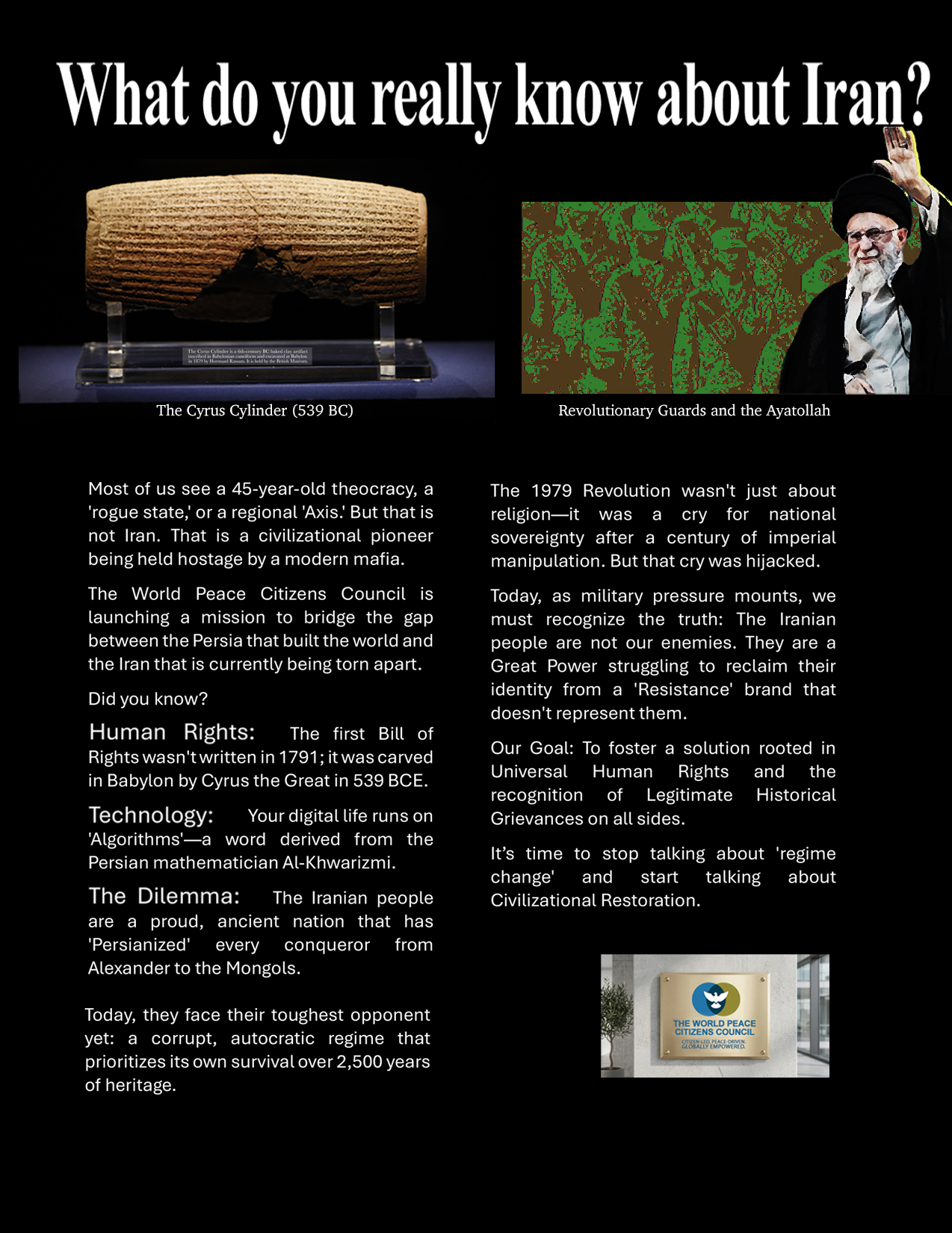
As of April 6, 2026, this type of campaign is more urgent than ever. While the world watches the intensifying war and ultimatums over the Strait of Hormuz, the Iranian people are caught in a brutal internal crackdown by a regime desperate to maintain control at any cost.
The “Emboldening” Effect
By validating their history, an effective PR campaign takes away the regime’s most effective weapon: the claim that the West hates “Iran” and its “culture.” If the West says, “We love Persia; we just oppose the mafia holding it hostage,” it gives the 89% of Iranians who want to change the moral clearance to fight for their identity without feeling like “Western puppets.”
As the IRGC is known for its own sophisticated digital influence campaigns, it is reasonable to expect them to try to label a citizens’ council as a “Western intelligence front.”
But, by maintaining a strict “Citizen-to-Citizen” focus and by keeping the conversation on culture and universal rights, it would be very difficult for them to attack such a council without looking like they are attacking their own heritage.
Time is running out and the dangers inherent in further aggressive military intervention are real. A viable solution to the problem will only be found by immediate de-escalation and a reframing of the entire goal of the west to reach a mutually acceptable resolution.


 hughchi